Reaction to Bad News
Video 1: Uber Crash

After scraping the YouTube comments of the most viewed video of the Uber crash, I conducted a sentiment analysis on the text. The overall sentiment score of the comments was -0.4214, which is surprisingly not very negative considering a pedestrian fatality occurred. I then explored how the comment sentiment changes before and after the fatal Tesla Autopilot crash that occurred only a few days after the Uber crash. The comment sentiment on the Uber crash video before March 23rd was -0.3317, while afterwards it was lower at -0.5319. From this sentiment analysis, it seems that there is a correlation and perhaps even spillover from other company AV crashes, even semi-autonomous, to how people feel about Uber.
In addition, I looked at the change in sentiment of the comments over time as displayed in the graph. Immediate reaction to the Uber crash video appears very diverse, supporting the notion of the two extreme thought bubbles on AVs. The comments are more negative following the Tesla crash, but then taper out.
Finally, I created a word cloud of the most common words from the video comments. Besides the most frequently typed words relating to 'cars' and 'Uber,' we see that many comments actually refer to the pedestrian herself. In particular, notice the accusatory language such as 'jaywalk' and 'stupid'. Despite the incident itself being inherently tragic, people seem to defend Uber and blame the pedestrian. Certainly, we still see accusatory language on the other side aimed at Uber as well.
Video 2: Uber Runs Red Light
I scraped the comments of another highly viewed video of a negative news event for AVs. In this video from December 2016, an Uber self-driving car appears to run a red light.
Again, I conducted a sentiment analysis on the comment text. The overall sentiment score of the comments was -0.0816, which is not incredibly negative. It is more positive than the first video as a red light run is less severe than a fatality.
Next, I looked at the change in sentiment of the comments over time as displayed in the graph. Again, the comments fall on a range of sentiments of the two extremes. The bulk of the comments are only near the video posting with a few isolated comments afterwards. More minor autonomous vehicle errors draw much less attention and even less negative sentiment.
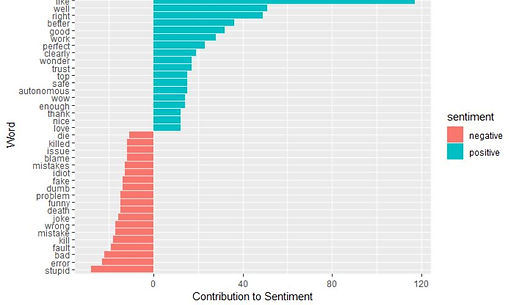
Finally, I plotted the most common words from the comments with their sentiment contribution as viewed in the graph. We see that despite the AV Uber having run a red light, most of the positive comment sentiment still trust autonomous vehicle technology with words such as 'better,' 'trust,' and 'perfect.' The negative sentiment contributing words focus on the potential implications of running a red light, such as 'death,' 'kill,' and 'problem.'
Overall, despite bad news relating to self-driving cars, people still support them. Even in the fatal crash, people are blaming people for poor turnouts and looking to AVs as a way to address our human shortcomings. However, there is a caveat that those who comment on such videos may involve self-selection.