Reaction to Waymo
All Waymo Videos
Google's Waymo is the pioneer and leader in the field of autonomous vehicles. They also maintain their own YouTube channel for all-Waymo related video content. Although I was not able to scrape the aggregate of all of their video's comments (restricted by YouTube API), I scraped the statistics. For each of the channel's videos, I pulled the number of views, dislikes, likes, and video publication date.
As displayed in the graph, I plotted the change in these statistics overtime before and after the major self-driving crashes. In particular, the pink lines mark the dates of the Uber pedestrian crash on March 18th (with the Tesla crash shortly after on March 23rd) and the Waymo incident on October 2nd. Before these crashes, the number of views on their videos is on average half as much as the amount of views on the videos post- and during the self-driving car crashes. The crashes not only sparked greater concern for AV technology, but also overall greater attention and interest in the field.
Furthermore, despite the post-crash videos having dramatically more views, the number of likes is significantly less. This decrease in proportion of views to likes may be a signal of the negative AV crash sentiment that is not reflected in the comments. Supporters of self-driving cars may be more motivated to post positive comments than critics to post negative comments.
Waymo Self-Driving Video
Published in 2017, this video is Waymo's introductory video on their self-driving cars. I scraped the comments of this highly viewed video to conduct sentiment analysis again. The overall sentiment score of the comments was 0.0297, which is slightly positive. Although this video is one of the first of its kind, it has a lower positive sentiment than the Tesla self-driving video. This may be due to the greater hype and following around Tesla.
I also analyzed the sentiment from the comments before and after major crashes. The video sentiment before the Waymo incident was 0.0233 and 0.0378 before the Uber crash. After the Waymo incident, the sentiment score was 0.0950, which is surprisingly more positive than before. Waymo has a track record of zero fatalities when it comes to their AV crashes, so a more minor crash did not stifle public sentiment. However, after the Uber crash, the score was -0.0031, a more negative sentiment. As with the case with Tesla, the AV crashes of other firms are correlated with how people feel about Waymo.
As displayed to the right, I created a word cloud of the most common words and their sentiment from the video. The Waymo self-driving video clearly draws a range of reactions across the negative to positive spectrum. This word cloud captures the inherent differences in sentiment towards AV technology with anticipation and surprise drawing the most feelings.
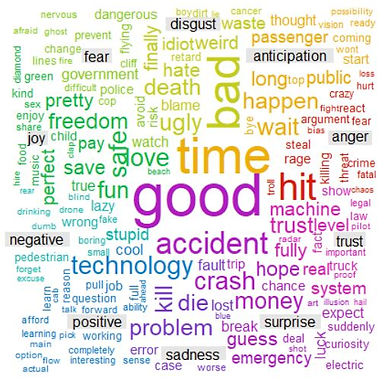
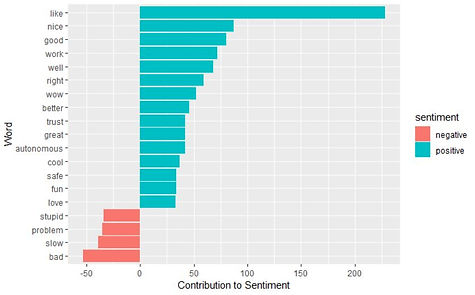
Finally, I plotted the most common words from the Waymo video comments with their sentiment contribution both before and after the Uber crash. Before the crash, the video sentiment was largely positive but also more tame. In contrast, the post-crash sentiment has not only more negative words but also more extreme senitment wordings from either side. After the crash, negative words like 'kill' and 'death' arise, while positive words like 'amazing' and 'perfect' show up. These are in contrast to the more passive negative words of 'bad' and 'slow' and the positive words of 'nice' and 'good' before the crash. The occurrence of the deadly Uber crash seemed to draw more extreme opinions from either side of the AV crowd. This is a recurring theme we have evaluated as a result of each of these crash analysis. As firms continue to test-drive AV technology and experience incidents, the public will continue to shape their opinions of the greatest evils and greatest goods of self-driving vehicles.
Waymo Video Sentiment Before Uber Crash
Waymo Video Sentiment After Uber Crash
